

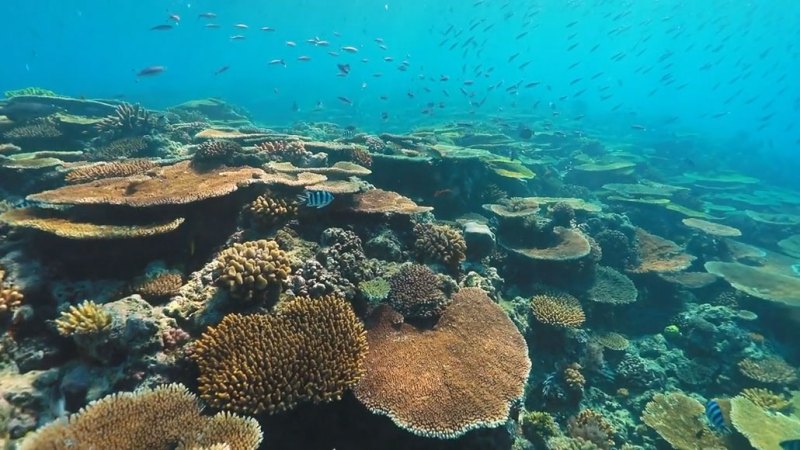
Take a plunge into Australia’s Great Barrier Reef, and you’ll come face to face with a what looks like a gorgeous rocky garden. This dazzling array of corals is the largest living structure on Earth. Some, like staghorn coral, look like leafless bushes sprouting from the ocean floor. Others, such as honeycomb coral, resemble rocks dotted with tiny holes. Then there’s brain coral, which, you guessed it, look like brains. And that’s just a small sample of the brilliant diversity to be found in a reef.
Despite their appearance, corals are animals. These invertebrates are close relatives of jellyfish and sea anemones. Most corals live in colonies of thousands of tiny individuals called polyps growing together. Each polyp sports a cylindrical body topped with a ring of tentacles surrounding its mouth.
“You can think of them as upside-down jellyfish,” says Peter Cowman. At Queensland Museum in South Brisbane, Australia, this marine biologist studies the evolutionary history of corals.




 English (US)